



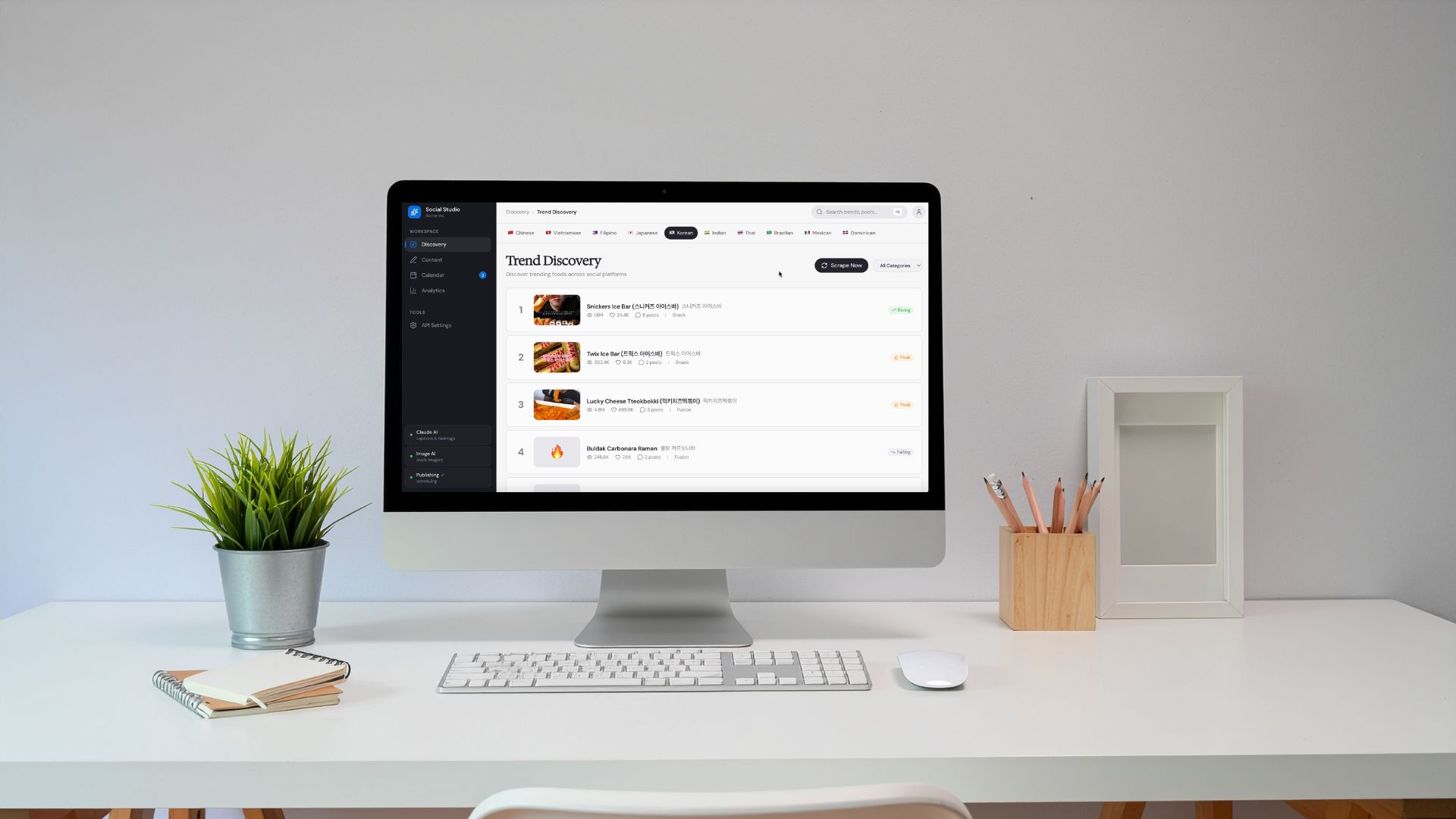
The food industry moves faster than research can keep up.
Food trends shift overnight — viral products, recipes, and ingredients spread across social platforms long before traditional market research catches them.
At America's #1 online ethnic grocer, marketing teams needed a faster way to spot trends relevant to specific ethnic audiences and turn them into content. As both a marketer and designer, I saw a chance to use AI to cut research time so teams could focus on strategy and execution.
Marketing teams couldn't move at the speed of food culture.
Trend research meant manually combing TikTok, Instagram, and Reddit — slow, inconsistent, and always a step behind.
Slow, inconsistent discovery
Manual research varied widely between marketers.
Late identification
Viral products were usually spotted after peak.
One-size-fits-all monitoring
Ethnic markets follow unique trend cycles that universal monitoring missed.
Manual content ideation
Turning trends into culturally relevant content took heavy brainstorming.
Scattered insights
Trend data lived across platforms and was hard to track over time.
“How might we help marketing teams spot emerging food trends earlier — and turn them into culturally relevant content faster?”
What it unlocked for the team.
Still early, but the platform delivered real operational gains:
- ~1 hr
Trend research time
Down from ~1 week.
- 50+
Ideas per week
Campaign-ready, up from a manual handful.
- 4
Ethnic market teams
Now share one source of trend intelligence.
Culturally specific visibility
Replaced a single universal feed.
A scalable foundation
For future AI-assisted marketing at the company.
How teams actually worked.
I interviewed and observed marketers. A few patterns surfaced repeatedly:
Platform switching
Validating one trend meant hopping across platforms.
Intuition over data
Trend calls leaned on gut feel, not structured data.
Momentum over size
Teams wanted to see how fast a trend was growing, not just how big it already was.
Disconnected ideation
Content brainstorming was a separate step that added friction.
Trends move differently across communities.
The same product can trend for different reasons in different communities — often weeks earlier in one before it reaches mainstream. That called for segmentation, not a universal dashboard.
What existing tools were missing.
Existing social-listening tools offered broad consumer insights but little ethnic-market specificity, no actionable content recommendations, and too much complexity for non-technical marketers.
Three principles guided the design.
- 01
Surface trends earlier
Continuously monitor social platforms to catch trends before they peak.
- 02
Organize insights by audience
Segment trends by ethnicity and market to surface culturally relevant opportunities.
- 03
Turn insights into action
Auto-generate content ideas to close the gap between discovery and creation.
An AI-powered trend intelligence platform.
One platform combining automated data collection, trend analysis, and content ideation — so marketers go from signal to social post without switching tools.
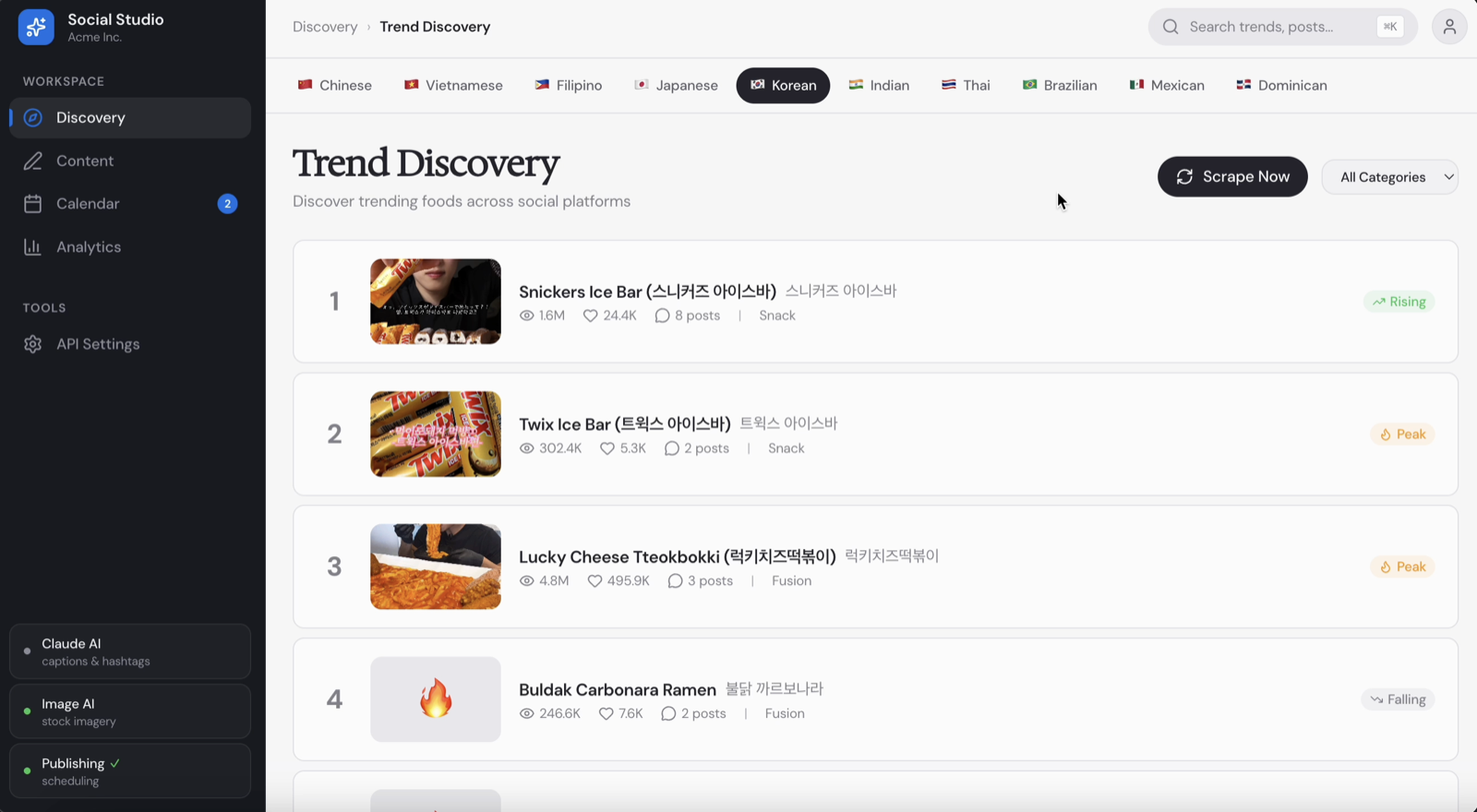
Emerging food conversations, in one place.
Automated scraping pipelines aggregate social data and continuously track emerging food conversations:
Trending products & ingredients
What's gaining traction across channels.
Trend growth indicators
How fast each trend is accelerating.
Historical tracking
How trends have shifted over time.
Cross-platform visibility
Signal unified across TikTok, Instagram, and Reddit.
Insights organized by audience segment.
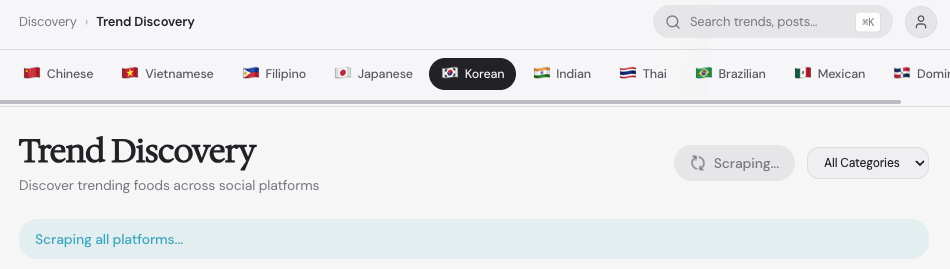
Instead of universal trends, the dashboard organizes insights by segment — so marketers can compare communities, spot culturally specific opportunities, and prioritize products for their target market.
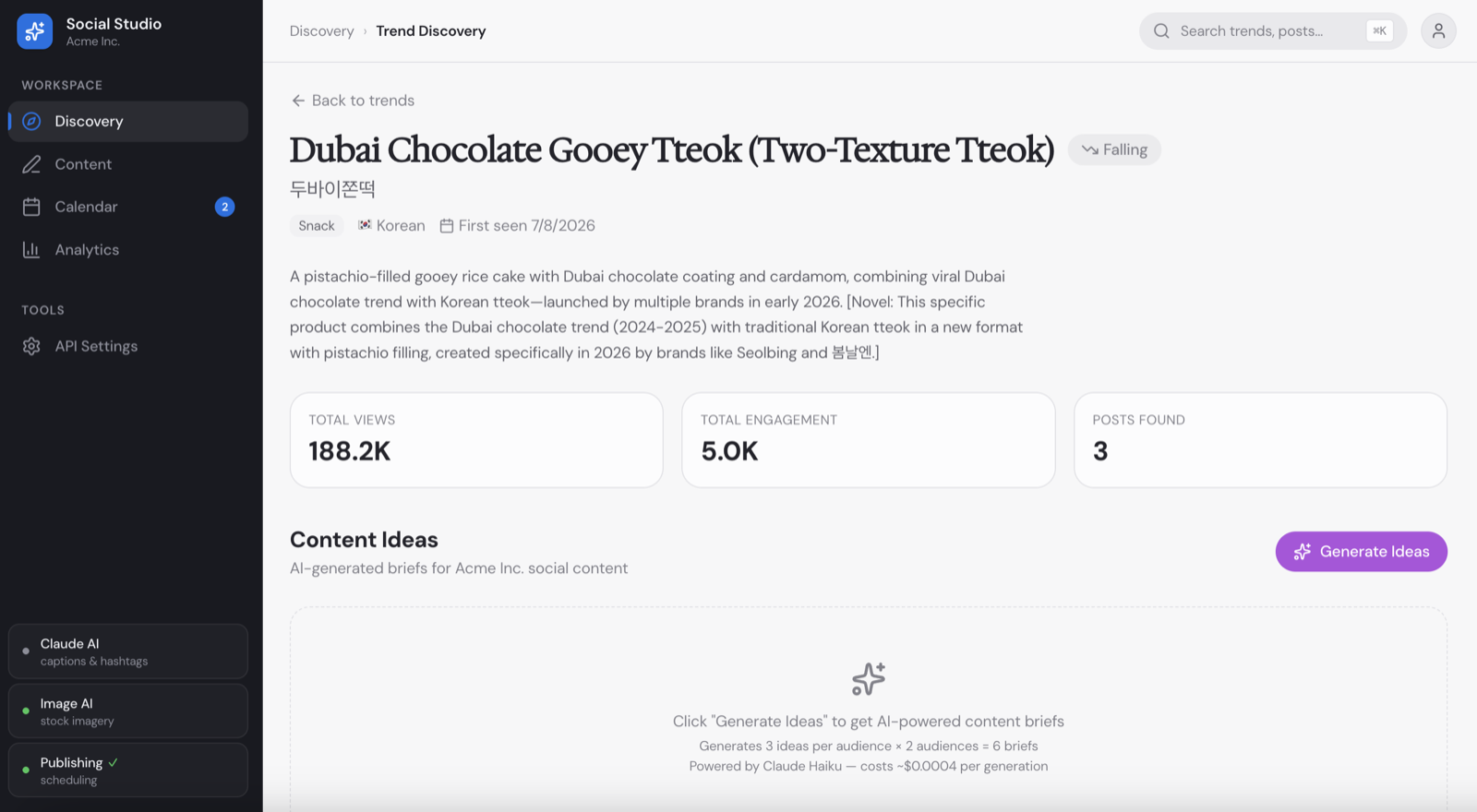
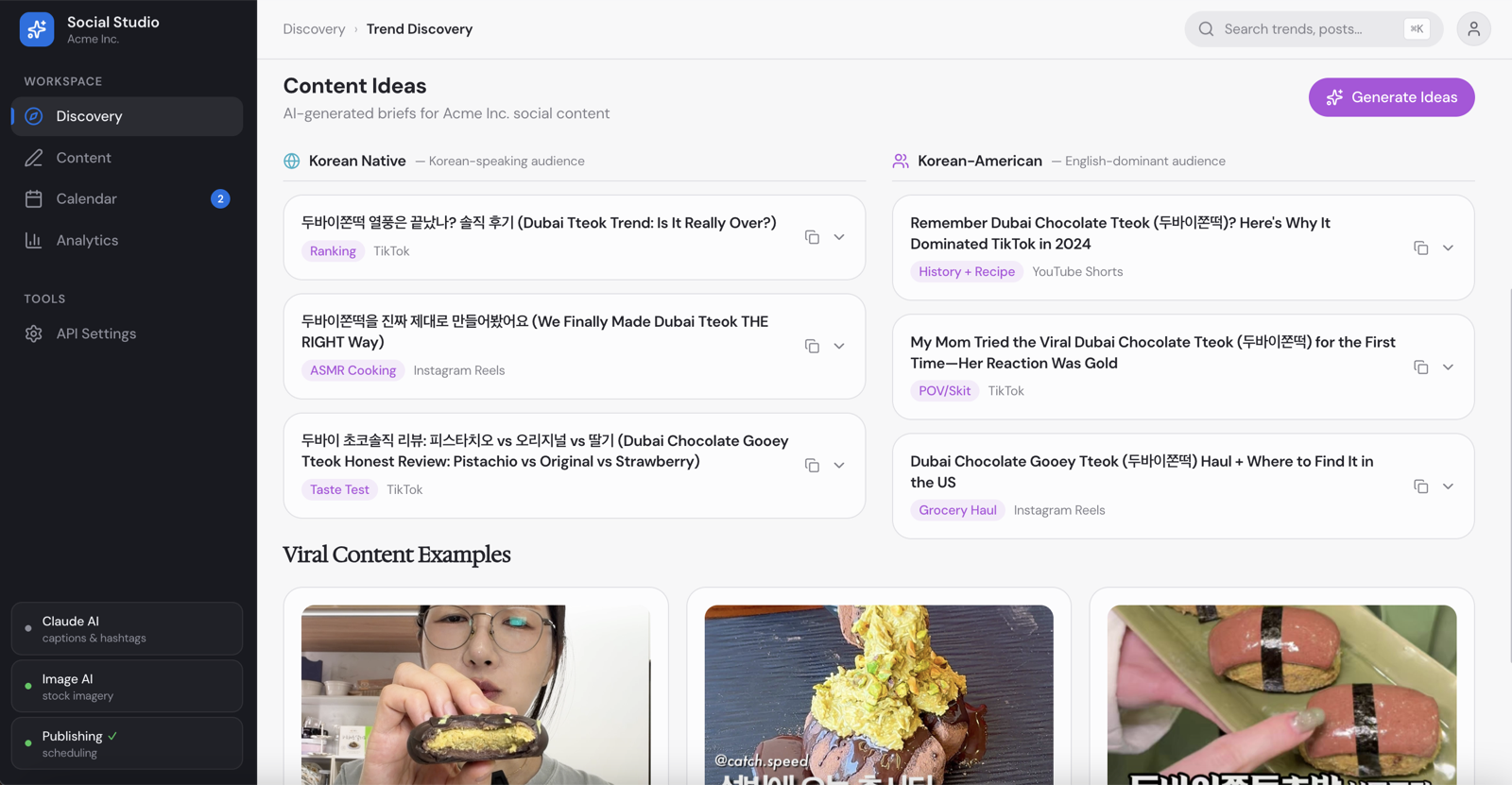
From trend to campaign in one place.
Once a trend surfaces, marketers instantly generate content concepts, video topics, campaign angles, and audience-specific messaging — collapsing the gap between research and execution.
Three calls that shaped how it works.
- 01
Signal over volume
Surfacing only trends with real momentum cut overload and raised decision confidence.
- 02
Discovery + ideation as one workflow
Marketers treated them as one loop, so I integrated them to kill context switching.
- 03
Built for non-technical users
AI, scraping, and a database run underneath, but the UI stays simple enough to act on without technical skill.
The value of AI products is rarely the AI itself.
It's reducing friction inside an existing workflow. I framed this as a trend-discovery problem, but research kept pointing elsewhere: the real gap was between spotting opportunities and acting on them.
Combining trend intelligence with content ideation let marketers move from insight to execution — and sharpened how I design AI-assisted workflows, turn operational pain into product opportunities, and balance automation with human judgment.